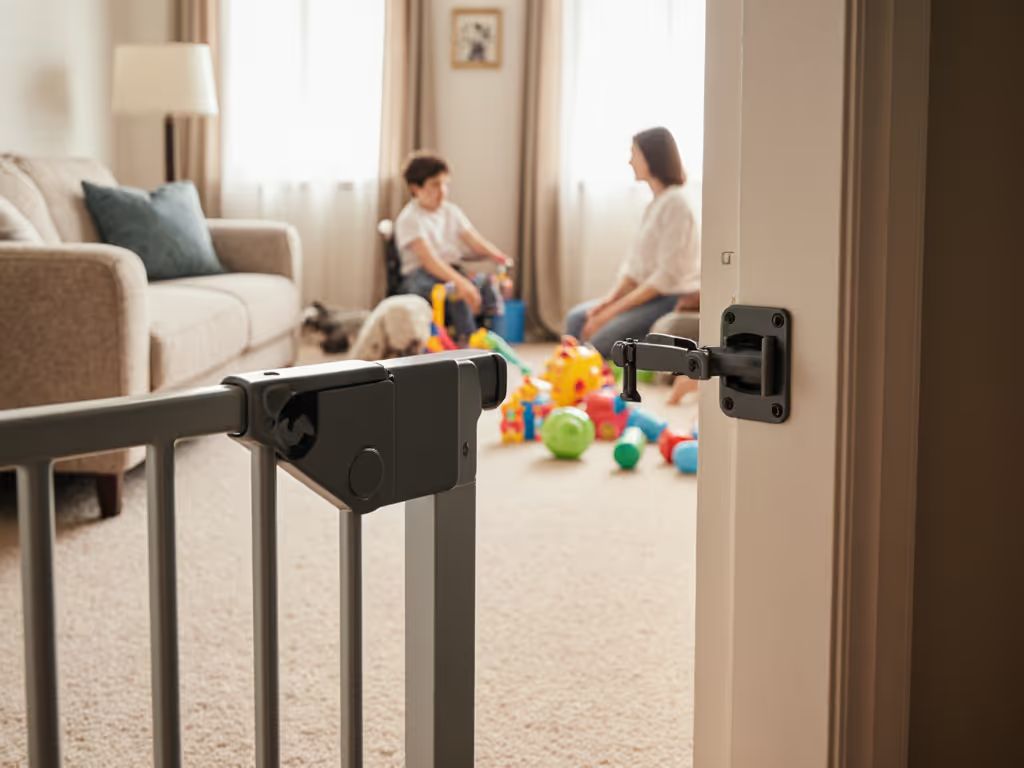
Baby Gate Timeline: How Safety Standards Evolved
By Arjun Mehta • 7th Mar
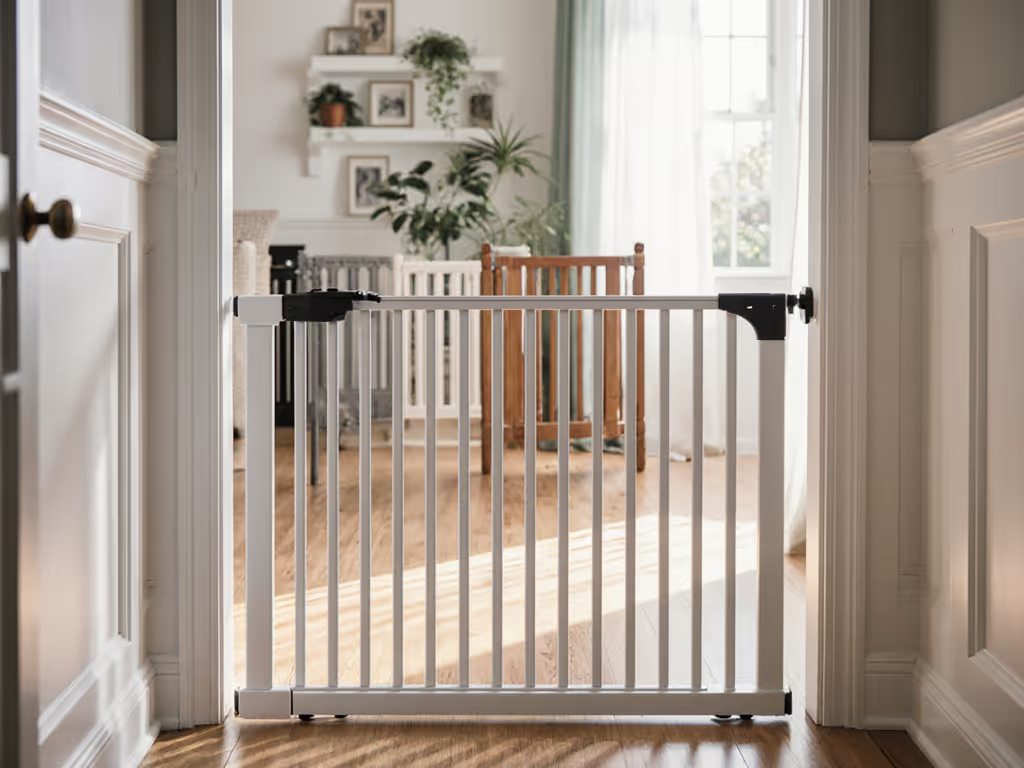
Why Baby Gates Started Getting Serious About Standards
Baby gates seem simple, a barrier to keep toddlers away from stairs or dogs out of nurseries. But the numbers tell a different story. Between 1990 and 2010, U.S. emergency departments treated an estimated 37,673 children for gate-related injuries, averaging 1,794 cases annually[2]. What's more alarming: the injury rate nearly quadrupled during that 20-year span, climbing from 3.9 per 100,000 children in 1990 to 12.5 per 100,000 in 2010[2]. These weren't minor bumps. More than 60 percent of injured children under age 2 suffered falls down stairs after gates collapsed or were left open, resulting in traumatic brain injuries and soft-tissue damage[2].
This trajectory forced a reckoning. Safety wasn't scaling with adoption. Marketing claims and voluntary guidelines weren't enough. Parents needed measurable assurance that a gate could hold a fall-prone toddler, resist climbing attempts, and stay mounted under real-world conditions.
What Was the First Standard, and When Did It Arrive?
The ASTM F1004 voluntary standard for gates and enclosures was first published in 1986[7]. Think of it as the industry's self-written rulebook. It established baselines for gate height, vertical strength, bottom spacing, opening sizes (to prevent head entrapment), and label warnings[2]. For nearly three decades, this guidance was optional, and manufacturers could adopt it, ignore it, or claim compliance without independent verification.
The catch: voluntary standards work only if the market rewards compliance and punishes cheating. That rarely happens in practice. Brands competed on aesthetics, price, and convenience, not on deflection under load or latching force at 30 pounds of child-shove pressure. Parents had no reliable way to compare gates against a common threshold.
Where Did Things Break Down?
Research pinpointed a clear split in how gates failed[4]:
- Children under age 2: Most injured by falls after gate collapse, with odds 6.72 times higher for younger kids[4]. These were pressure-mounted gates flexing under minimal weight or latches failing at critical moments.
- Children aged 2-6: Most injured by climbing contact with the gate itself, cuts from edges, finger pinches, falls from clambering over the top[4]. Designs with notches, gaps, or low crossbars turned gates into unintended climbing structures.
The research team highlighted what the voluntary standard missed: designs that actively limited climbing ability, mechanisms that prevented collapse under stress, and energy-absorbing surfaces if a child did fall into the gate[2]. The label warnings, buried in instruction manuals, weren't reaching parents at the moment of purchase or installation.
When Did Federal Mandate Replace Voluntary Guidelines?
In 2020, the Consumer Product Safety Commission (CPSC) published final rules for Gates and Enclosures in the Federal Register[1][7]. This was the shift from should to must. Manufacturers could no longer treat F1004 as optional guidance. Compliance became legally enforceable.
The timing mattered. Nearly three decades of injury data, recall notices, and expert consensus had built a case that voluntary compliance left too many families exposed. CPSC had the authority; manufacturers had the capability. The question became regulatory will, and the data won that argument.
What Changed in the 2020 Standard?
The mandatory rule tightened several areas:
- Installation warnings: Now required on external packaging, not just buried in manuals[6]. Parents see the risk of improper mounting before purchase.
- Scope expansion: Standards now address how gates interact with stair configurations, swing direction, and hinge alignment, not just isolated component strengths.
- Climb-resistance testing: Gates are evaluated for their resistance to toddler climbing, with specific force thresholds[1].
- Collapse testing: Pressure gates must hold defined loads without flexing beyond safe limits.
Hard stop: top of stairs needs hard mounting. For a deeper dive into why hardware mounts are mandatory at stair tops, read our pressure vs hardware-mounted comparison. The standard recognized that pressure-mounted gates, even compliant ones, introduce unacceptable risk when a fall means tumbling down stairs. This isn't marketing; it's threshold engineering.
Did International Standards Align?
Europe developed its own pathway. EN 1930 established standards for safety gates and pet gates for indoor use[3]. EN 71 set material safety requirements, testing whether children could get their head, hip, or leg stuck and whether objects could create choking hazards[3]. These ran parallel to U.S. standards, sometimes with different specificity around materials and entrapment testing. For a side-by-side look at how U.S., EU, Canada, and Australia differ, see our international baby gate standards guide.
The U.S. approach leaned harder into structural failure modes (collapse, climb resistance) and adult workflow (swing direction, one-handed operation for caregivers carrying infants). European standards emphasized material toxicity and entrapment prevention. Both mattered; neither was complete without the other.
What Gaps Remain in Today's Standards?
Mandatory standards solved the baseline problem but didn't eliminate judgment calls:
- Space-specific fit: Standards don't account for baseboards, quarter-round trim, textured plaster, or banisters with unusual spacing. A gate rated "compliant" might flex 2 inches when mounted over uneven surfaces (technically within deflection limits but not confidence-inspiring[2]). Measured flow matters more than certification alone.
- Pet-gate conflicts: Standards focus on child safety but don't address dog-pushing force or litter-box access in multi-pet households. For solutions that work for both pets and children, check our guide to self-closing pet gates for multi-pet homes.
- Rental adaptations: Pressure mounts lose tension over time on rental drywall. The standard doesn't differentiate between owner-safe drilling and damage-inducing fasteners.
- Adult usability: A gate that meets every structural requirement can still be awkward one-handed or swing the wrong direction for a high-traffic zone. Standards don't test for "flow friction."
How Should You Use This Timeline to Make Better Choices?
Understand the trajectory: safety evolved through injury data and regulatory pressure, not industry initiative alone. Gates made in 2026 are objectively safer, more rigorously tested for collapse, climbing, and installation, than gates from 1990. But standards set minimums, not ideals.
Use that knowledge to ask harder questions:
- Is this gate hardware-mounted (bolted) or pressure-mounted (wedged)? Top-of-stairs placement requires bolted installation; pressure gates are not a legitimate option for that zone. Need help setting up a safe bottom-of-stairs configuration with a pressure gate? Follow our bottom-of-stairs setup guide.
- Can you physically measure the gate's deflection in your actual opening before committing? Request deflection specs under realistic load, not just marketing claims.
- Does the swing direction match your household flow? Will it trap fingers or block access during emergencies?
- Is the latch one-handed and silent, or will you wake sleeping children?
- How will pets interact with it, and does that change where you place it?
What's the Biggest Lesson From 30 Years of Gate Standards Evolution?
Numbers win arguments. Measured flow prevents everyday mistakes and near-misses. A gate rated "safe" by 2020 standards is fundamentally better than one from 1995, but your specific installation (your baseboards, your stairs, your household rhythm) is where fit predicts safety better than any label. The timeline shows that standards lag behind injury reality by years, sometimes decades. Don't wait for the next revision to upgrade a gate that flexes, creaks, or feels misaligned in your space. Trust the data, measure your setup, and swap it for a configuration that passes your own inspection, not just the CPSC's.
Where to Find Deeper Information
The CPSC website maintains current safety standards, recall notices, and injury surveillance data through its NEISS system. Academic databases hold the epidemiologic research behind these standards, start with the 2014 McKenzie study comparing pre- and post-standard injury patterns. If you're navigating a complex installation, reach out to manufacturers for hardcopy specs on deflection, mounting options, and compatibility with your exact opening. Don't settle for generic assurances. Demand precision: dimensions, forces, and failure modes.
Related Articles